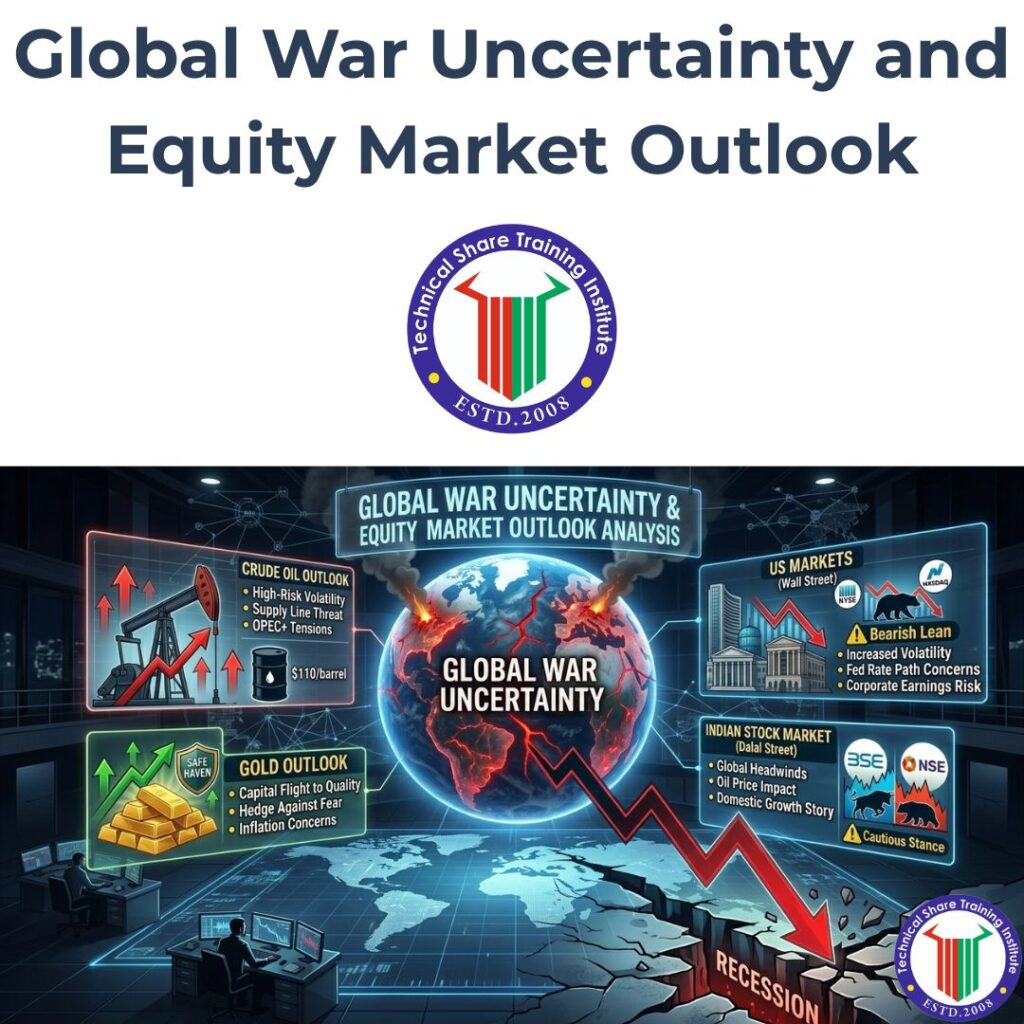
Global War Uncertainty and Equity Market Outlook – Analysis by Sahil Goyal
The global financial markets are currently facing a period of high geopolitical tension and economic uncertainty. Conflicts between major nations, rising commodity prices, and policy challenges in global economies have created volatility across equity markets.
Investors around the world are asking several important questions:
Will a World War happen?
Will commodity prices like crude oil, gold, and silver rise further?
Can global equity markets crash?
What will happen to the US stock market?
How will the Indian stock market be affected?
In this detailed equity market analysis, we will examine these factors and understand the potential short-term and long-term outlook for global markets.
This analysis perspective reflects the views often discussed by market educator Sahil Goyal, founder of Technical Share Training Institute, who focuses on global macro trends and practical market analysis.
- Table of Contents
Introduction: Global Market Uncertainty
What Is Driving Current Geopolitical Tension
Will a World War Happen?
Impact of War Uncertainty on Global Markets
Commodity Price Outlook – Crude Oil, Gold and Silver
Supply Chain Disruptions and Global Trade
Inflation Risk in Major Economies
US Stock Market Outlook
Federal Reserve Policies and Economic Pressure
Rising Unemployment and Economic Slowdown
Short-Term Outlook for the US Market
Long-Term Outlook for the US Economy
Global Investor Sentiment
Impact on Emerging Markets
Indian Stock Market Outlook
Role of Foreign Institutional Investors (FII)
Domestic Strength of the Indian Economy
Government Policies and Economic Stability
Investment Strategy During Global Uncertainty
Conclusion: What Investors Should Focus On
About Sahil Goyal
About Technical Share Training Institute
Join Our Share Market Course
Frequently Asked Questions (FAQ)
Introduction: Global Market Uncertainty
Financial markets operate based on confidence and expectations. When geopolitical conflicts increase, uncertainty spreads across financial systems.
In the past few years, global markets have faced several challenges:
Wars and geopolitical tensions
Supply chain disruptions
Inflation pressure
Policy mistakes by governments
Energy shortages
These factors have created volatility in equity markets and commodities.
Investors worldwide are carefully watching developments related to international conflicts and economic policies.
What Is Driving Current Geopolitical Tension
The current uncertainty is mainly driven by rising tensions between major geopolitical powers.
These tensions include:
Conflicts in the Middle East
Strategic competition among global powers
Economic sanctions between countries
Military build-ups across different regions
Countries are increasing defense budgets and preparing for potential conflicts, which increases fear in financial markets.
However, preparation for war does not always mean war will happen.
Will a World War Happen?
One of the biggest questions investors ask is whether the world could enter another large-scale global war.
At present, the probability of a full-scale world war appears relatively low.
There are several reasons for this:
Major economies are highly interconnected through global trade.
A large war would cause severe economic damage to all nations.
Countries like the United States and Iran are not currently in a position to initiate a global conflict.
Instead, most countries are strengthening their military and strategic capabilities for future preparedness.
In the near term, the global situation is more likely to remain in a phase of strategic tension rather than direct world war.
Impact of War Uncertainty on Global Markets
Even if a large war does not occur, uncertainty alone can impact markets significantly.
Global markets react to uncertainty in several ways:
Increased volatility
Capital moving toward safe assets
Rising commodity prices
Reduced investor confidence
When geopolitical risk increases, investors often shift money toward gold, commodities, and defensive sectors.
Commodity Price Outlook – Crude Oil, Gold and Silver
Commodity prices have already seen a strong rise in the last one to one and a half years.
Geopolitical tensions and supply disruptions have been major drivers of this trend.
Crude Oil
Oil prices tend to rise during geopolitical conflicts because supply routes may be threatened.
Possible reasons for crude oil price increases:
Supply shortages
Production disruptions
Transportation risks
Strategic stockpiling by governments
Crude oil prices may continue to remain volatile in the coming years.
Gold
Gold is traditionally considered a safe-haven asset.
During periods of global uncertainty, investors increase gold allocations to protect their capital.
This demand often leads to strong price increases.
Silver
Silver also benefits from both:
Industrial demand
Safe-haven investment demand
If global uncertainty continues, silver prices could also remain strong.
Supply Chain Disruptions and Global Trade
War tensions affect global supply chains.
Major impacts include:
Shipping disruptions
Trade restrictions
Rising logistics costs
Manufacturing delays
These disruptions can reduce supply of important goods and increase production costs worldwide.
Inflation Risk in Major Economies
Supply disruptions and rising commodity prices directly contribute to inflation.
Higher inflation creates challenges for central banks because they must balance economic growth with price stability.
Inflation has already become a major issue in many developed economies.
US Stock Market Outlook
The US stock market has been facing continuous pressure in recent periods.
Several factors have contributed to this:
High inflation
Interest rate pressures
Economic slowdown fears
Rising unemployment concerns
Major US indices like the S&P 500 and Nasdaq Composite have experienced volatility.
Federal Reserve Policies and Economic Pressure
Policy decisions by governments and central banks play a crucial role in market stability.
In recent years, many analysts believe policy implementation in the United States has faced challenges.
While creating economic policies is one aspect, implementing them effectively at the right time is equally important.
Incorrect timing or execution can lead to unintended economic consequences.
Rising Unemployment and Economic Slowdown
Economic indicators in the United States have shown signs of pressure.
Possible risks include:
Rising unemployment
Slow economic growth
Reduced corporate profitability
If these factors continue, the US market may experience further downside pressure in the short term.
Short-Term Outlook for the US Market
In the short term, the US market may remain volatile and potentially face further corrections.
Key risks include:
Continued inflation pressure
Weak economic growth
Policy uncertainty
Investors may remain cautious until clearer economic signals emerge.
Long-Term Outlook for the US Economy
Despite short-term challenges, the United States remains one of the strongest economies globally.
Over the long term, innovation, technology leadership, and economic strength may help the US market recover.
However, the short-term trend could remain under pressure.
Global Investor Sentiment
Investor sentiment globally is currently influenced by:
Geopolitical tensions
Interest rate uncertainty
Commodity price increases
These factors cause investors to adopt a risk-off approach, reducing exposure to equities and moving capital toward safer investments.
Impact on Emerging Markets
Emerging markets are often affected by global capital flows.
When uncertainty increases, global investors withdraw money from emerging markets and move funds toward safer assets.
This can create pressure on developing economies.
Indian Stock Market Outlook
The Indian Stock Market has also been experiencing volatility due to global sentiment.
Even though India’s domestic economy remains strong, global uncertainty has impacted investor confidence.
Foreign Institutional Investors (FII) have been withdrawing capital from the market, which has contributed to downward pressure.
Role of Foreign Institutional Investors
FIIs play an important role in the Indian stock market.
When global uncertainty increases, FIIs often reduce their exposure to emerging markets.
This capital outflow can create short-term market corrections.
Domestic Strength of the Indian Economy
Despite global challenges, the Indian economy has several strengths.
Government policies under Narendra Modi have focused on:
Infrastructure development
Manufacturing growth
Domestic consumption
Digital transformation
These policies have strengthened the domestic economic foundation.
Government Policies and Economic Stability
Domestic economic policies in India have supported growth.
However, even strong domestic fundamentals cannot fully shield markets from global sentiment.
Therefore, the Indian market may remain under pressure if global uncertainty continues.
Investment Strategy During Global Uncertainty
During uncertain times, investors should focus on disciplined strategies.
Key strategies include:
Diversification
Long-term investing
Risk management
Avoiding emotional decisions
Understanding global macro trends can help investors navigate volatility more effectively
Conclusion: What Investors Should Focus On
The current global environment is marked by uncertainty, but a full-scale world war appears unlikely in the near term.
However, geopolitical tensions can still impact markets through:
Commodity price increases
Inflation pressures
Capital market volatility
The US market may face short-term downside risks, while India remains fundamentally strong but influenced by global sentiment.
Investors should focus on long-term strategy and disciplined investing rather than reacting emotionally to short-term market movements.
About Sahil Goyal
Sahil Goyal is a stock market mentor and the founder of Technical Share Training Institute.
He has trained thousands of students in stock market trading and investment strategies.
His focus is on:
Practical trading education
Technical analysis training
Risk management strategies
Long-term investment understanding
About Technical Share Training Institute
Technical Share Training Institute is a recognized stock market coaching institute providing professional trading education since 2008.
The institute offers training programs for beginners and experienced traders.
Courses include:
Technical analysis
Intraday trading
Options trading
Portfolio management
Training is available in both online and offline modes for students across India.
Join Our Share Market Course
If you want to learn how to analyze markets and understand global financial trends, joining a professional trading course can help you build the right skills.
Technical Share Training Institute provides structured stock market training with practical learning methods.
Students learn how to analyze charts, manage risk, and make informed trading decisions.